My Stories

Here the great stories you could read

The Hedgehog who was afraid of the dark

Fiction

Once there was a little hedgehog named Plip who loved the golden sun, but he trembled whenever the pale moon climbed into the sky. While his friends went out to forage for crunchy beetles and sweet fallen apples, Plip stayed tucked inside his nest of dry leaves, shivering. "The dark is too big," Plip would whisper to his mother. "It swallows the trees and hides the paths."

One evening, a wise old owl named Barnaby landed on a branch above Plip's nest. "Little one," Barnaby hooted softly, "the dark does not hide the world; it simply changes the colors. Look up." Plip peeked out with one eye. Above the dark trees, thousands of tiny, silver lights were blinking. "Those are stars," Barnaby explained. "They are the night's candles. And look there the moon isn't a monster; it's a glowing map showing you the way to the best berry bushes."


Plip took a tiny, shaky step onto the damp moss. He realized the night air smelled like jasmine and rain. He saw a firefly dance past his nose, leaving a trail of neon green. For the first time, Plip wasn't shivering from fear—he was shivering with excitement. He trotted off into the woods, his quills rattling like tiny bells, finally ready to see the magic that only happens when the sun goes down.

Aerospace Engineering                         

Non-Fiction

The Busy Sky Above

Have you ever looked up at the sky and wondered what’s going on up there? It might look empty, but it’s actually full of movement. High above your head, airplanes are carrying people across the world, and rockets are launching into space. Airplanes, like the Boeing 747, fly through the air using their wings. As they move forward, air flows over and under the wings, helping lift them into the sky. That’s how people can travel from one country to another in just a few hours.

Rockets are very different. A rocket such as the Saturn V doesn’t need air to fly. Instead, it pushes itself upward by blasting hot gases out of its engines. This idea comes from a rule discovered by Isaac Newton: for every action, there is an equal and opposite reaction. While airplanes stay close to Earth, rockets go much farther. They can carry astronauts, satellites, and even robots into space. Organizations like NASA use rockets to explore places far beyond our planet. Even though airplanes and rockets are different, they both do something amazing—they fight against gravity to fly.

How They Fly

An airplane flies by using wings to create lift. As it moves forward, air flows over and under the wings, pushing it upward. Engines provide thrust to keep it moving, while pilots control the direction and speed. Although gravity pulls it down, the balance of lift and thrust keeps it steady in the air.

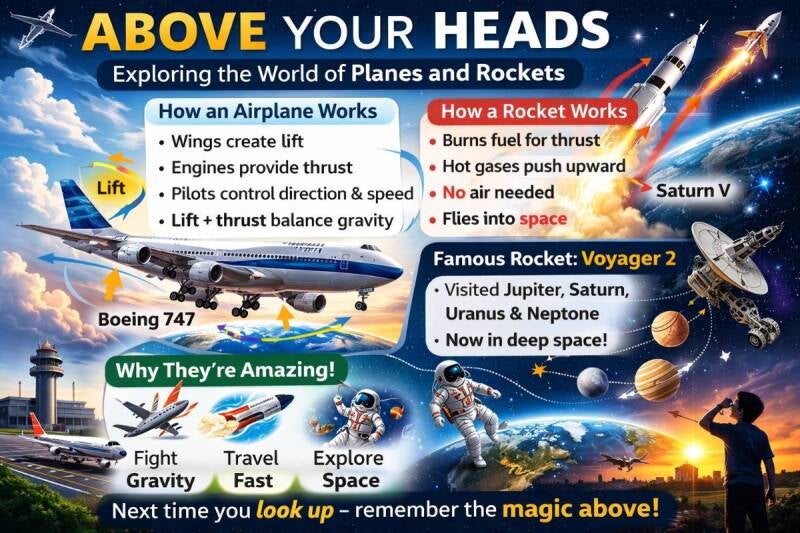
In contrast, a rocket works by burning fuel to create powerful thrust. Hot gases shoot out of the engine, pushing the rocket upward. Because it does not need air, it can travel through the vacuum of space. Rockets must overcome gravity and reach incredibly high speeds to carry satellites, equipment, or astronauts beyond Earth’s atmosphere.

Exploring the Unknown

One of the most famous examples of this technology is Voyager 2. Launched in 1977, Voyager 2 is a robotic space probe designed to explore the outer reaches of our solar system. It remains the only spacecraft to have visited all four giant outer planets—Jupiter, Saturn, Uranus, and Neptune—at close range. So remember, every time you look up at the sky, think about all the magic going on out there.